October 29, 2022

Nitro Shock Absorber

For a smooth and comfortable ride the disturbing forces should be eliminated or reduced considerably by using some devices. Shock absorbers are such devices which isolate the vibrations by absorbing some disturbing energy themselves. Of the many types telescopic shocks are widely used which has got the draw back that the flow of oil in the cylinder can cause foam of oil and air to form.

These limit the optimum throughout of the flow in the valves. Gas shocks represent an advance over traditional shocks. Nitrogen filled gas shock absorbers are the results of years of extensive research and development with top flight shock design engineers.

They are designed for both lowered and stock vehicles to provide shock absorbers that would out perform anything on the market today. Nitro shock absorbers are high quality, nitrogen filled shocks designed and gas charged specifically for each vehicle application. The addition of nitrogen under pressure limits the foaming effect and increases efficiency.


SHOK ABSORBER ACTION

Shock absorbers develop control or resistance by forcing fluid through restricted passages. A cross-sectional view of a typical shock absorber is shown below. Its main components and working is also given below.

 
The upper mounting is attached to a piston rod. The piston rod is attached to a piston and rebound valve assembly. A rebound chamber is located above the piston and a compression chamber below the piston. These chambers are full of hydraulic fluid. A compression intake valve is positioned in the bottom of the cylinder and connected hydraulically to a reserve chamber also full of hydraulic fluid. The lower mounting is attached to the cylinder tube in which the piston operates.

During compression, the movement of the shock absorber causes the piston to move downward with respect to the cylinder tube, transferring fluid from the compression chamber to the rebound chamber. This is accomplished by fluid moving through the outer piston hole and unseating the piston intake valve.

During rebound, the pressure in the compression chamber falls below that of the reserve chamber. As a result, the compression valve will unseat and allow fluid to flow from the reserve chamber into the compression chamber. At the same time, fluid in the rebound chamber will be transferred into the compression chamber through the inner piston holes and the rebound valve.

ADVANTAGES OF NITRO SHOCKS

Instantaneous response :

Because the high pressure eliminates aeration (foaming), action is always is immediate.
 
The low mass of gas and the single tube further improves response time.

Better fade resistance :

Since there is no outer tube, cooling is much better which gives a drastic reduction in fade. Thus more consistent handling and control.

Better durability :

Single-tube construction also allows for a larger internal working area, reducing stress and fatigue for better durability.
 
De Carbon’s monodisc valving system features a single moving part that drastically reduces inertia and friction, to improve durability and performance.
 
Better cooling of the mono tube design results in lower operating temperatures and thus longer life.
 
No need for re-adjustment:

The viscosity of hydraulic fluid changes as temperature changes. This may because of climate, season (summer/winter) or heavy duty (motorway cruising). The high pressure gas compensates immediately and automatically for changes in viscosity.

In the current scenario of automobile industry the need for vehicles which provides smooth and comfort ride is growing. Nitro shock absorbers are designed to be ultimate in performance and comfort. In a country like ours whose roads are not up to world standards the need for automotive components like nitro shocks are necessary. It goes without saying that if the right choice is made the improvements in vehicles ride and handling can be shocking.

Airless Tyre

Anyone who has ever driven a car run on a flat tire, but what if your tires could never go flat? In recent years a number of companies and inventors have been working on creating airless tires that would be impossible to puncture. Non-pneumatic tires (NPT), or Airless tires, are tires that are not supported by air pressure. They are used on some small vehicles such as riding lawn mowers and motorized golf carts. They are also used on heavy equipment such as backhoes, which are required to operate on sites such as building demolition, where tire puncture is likely. Tires composed of closed-cell polyurethane foam are also made for bicycles and wheelchairs. The main advantage of airless tires is that they cannot go flat, but they are far less common than air-filled tires.

The most well known design in this field is the Michelin Tweel, a combination wheel and tire. The design was one of the first to emerge, bringing the idea of non-pneumatic tires to the public's attention. But Michelin has been slow to roll out the technology beyond the test phase.in light of this; a company called resilient technologies has also been working on an airless tire. The company recently announced that prototypes of their honeycomb-like tires will ship in 2011 for use in the US military. This will no doubt help the airless tire field, as will other startup companies working on the task like Britek.

AIRLESS TIRES
Non-pneumatic tires (NPT), or Airless tires, are tires that are not supported by air pressure. Airless tires generally have higher rolling friction and provide much less suspension than similarly shaped and sized pneumatic tires. Other problems for airless tires include dissipating the heat buildup that occurs when they are driven. Airless tires are often filled with compressed polymers (plastic), rather than air.
 

The Tweel (a portmanteau of tire and wheel) is an experimental tire design developed by the French tire company Michelin. The tire uses no air, and therefore cannot burst or become flat. Michelin is currently developing an integrated tire and wheel combination, the "Tweel” that operates entirely without air. Automotive engineering group of mechanical engineering department at Clemson University is developing a low energy loss airless tire with Michelin through the NIST ATP project. The Tweel would be the most radical change in the tire industry since the radial tire was invented nearly 60 years ago. Other changes include no more deadly blowouts. And in time, no more used-tire mountains or the need for as many shredding and recycling stations.


The Tweel is durable. Forget a nail, an armored vehicle with Tweel can go over an exploding landmine and keep moving. But for the car, the Tweel is still just a concept. On a test drive on tweels, a sedan handles well enough. The biggest problem is noise, once the speed hits about 50 mph. The noise gets worse the faster you go.

WORKING


When the Tweel is put to the road, the spokes absorb road impacts the same way air pressure does in pneumatic tires. The Tweel's hub connects to flexible polyurethane spokes which are used to support an outer rim and assume the shock-absorbing role of a traditional tire's pneumatic properties. The tread and shear bands deform temporarily as the spokes bend, then quickly spring back into shape. Tweels can be made with different spoke tensions, allowing for different handling characteristics. More pliant spokes result in a more comfortable ride with improved handling.

The lateral stiffness of the Tweel is also adjustable. However, you can’t adjust a Tweel once it has been manufactured. You’ll have to select a different Tweel. For testing, Michelin equipped an Audi A4 with Tweels made with five times as much lateral stiffness as a pneumatic tire, resulting in very responsive handling.
 
Michelin reports that the Tweel prototype is within five percent of the rolling resistance and mass levels of current pneumatic tires. That translates to mean within one percent of the fuel economy of the tires on your own car. Since the Tweel is very early in its development, Michelin could be expected to improve those numbers.

THE FUTURE OF AIRLESS TIRES
The first large-scale applications may be in the military where a flat-proof tire would be advantageous. Military testing has indicated that the Tweel deflects mine blasts away from the vehicle better than standard tires and that the Tweel remains mobile even with some of the spokes are damaged or missing. NASA has contracted Michelin to develop a wheel for the next generation Lunar Rover based on the Tweel.[3] This has resulted in the Lunar Rover Initiative AB Scarab wheels. The Tweel does have several flaws (aside from the name). The worst is vibration. Above 50 mph, the Tweel vibrates considerably. That in it might not be a problem, but it causes two other things: noise and heat. A fast moving Tweel is unpleasantly loud. Long-distance driving at high speeds generates more heat.
 
Another problem involves the tire industry. Making Tweel is quite a different process than making a pneumatic tire. The sheer scale of the changes that would need to be made to numerous factories, not to mention tire balancing and mounting equipment in thousands of auto repair shops, presents a significant (though not insurmountable) obstacle to the broad adoption of airless tires.
 

CAD-CAM Technology

(CIM) computer integrated manufacturing is a recent technology being tried in advance computer and it comprises a combination of software and hardware for product design, product planning, product control, product equipment and product process.


In this CIM technology CAD/CAM play an effective role. CAD/CAM system is ideally suited for designing and manufacturing mechanical components of free from complex 2-dimensional and 3-dimensional shapes.

CAD/CAM technology plays an important role in functioning of robots. In CAD/CAM system the robot work data is prepared from CAD data from the first designing process. This system is a kind of off-line teaching system. Since an actual robot is not used to input data for path creation, the coordinate system data must be corrected and simulations necessary before loading a created data.


Robots are inevitable for application in the field where the work is extremely difficult or impossible for human being to perform.

Some of such examples are: Work requiring speed, precision or function exceeding human ability, or that which requires entering a sterile environment, vacuum, outer space, or around a nuclear reactor, places that a man cannot enter easily or at all.

Computer Aided Design and Computer Aided Manufacture is the way things are made these days. Without this technology we wouldn’t have the range and quality of products available or, at least, they wouldn’t be available at a price most of us can afford.

Hand-building and manual techniques still very much have their place and Design Education needs to treasure and foster these skills so that future generations will have the ‘hands-on’ skills to understand the man-made world and provide the next generation of engineers, designers and technicians.

All of these professionals will be using CAD/CAM techniques or CAD/CAM products in their work, alongside practical hands-on skill. Design and Technology education has to reflect modern practice so it is crucial that students have the opportunity to use real CAD/CAM tools in their designing and Making.

USES

Computer-aided design is one of the many tools used by engineers and designers and is used in many ways depending on the profession of the user and the type of software in question.

CAD is one part of the whole Digital Product Development (DPD) act ivity within the Product Lifecycle Management (PLM) processes, and as such is used together with other tools, which are either integrated modules or stand-alone products, such as:
  • Computer-aided engineering (CAE) and Finite element analysis (FEA)
  • Computer-aided manufacturing (CAM) including instructions to Computer Numerical
  • Control (CNC) machines
  • Photo realistic rendering
  • Document management and revision control using Product Data Management (PDM).

CAD is also used for the accurate creation of photo simulations that are often required in the preparation of Environmental Impact Reports, in which computer-aided designs of intended buildings are superimposed into photographs of existing environments to represent what that locale will be like were the proposed facilities allowed to be built. Potential blockage of view corridors and shadow studies are also frequently analyzed through the use of CAD.

CAD has been proven to be useful to engineers as well. Using four properties which are history, features, parameterization, and high level constraints. The construction history can be used to look back into the model's personal features and work on the single area rather than the whole model. Parameters and constraints can be used to determine the size, shape, and other properties of the different modeling elements.

The features in the CAD system can be used for the variety of tools for measurement such as tensile strength, yield strength, electrical or electro-magnetic properties. Also its stress, strain, timing or how the element gets affected in certain temperatures, etc.

Solar Based Refrigerator

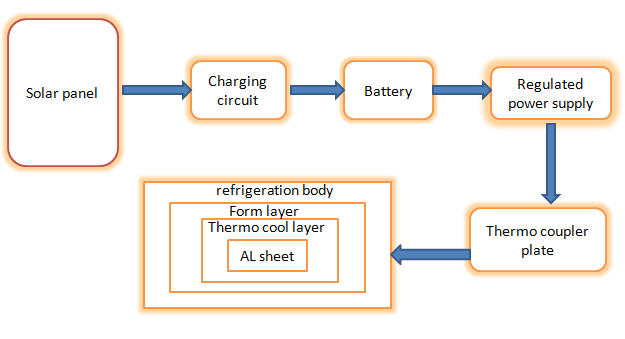
As the trend changes the consumption of electricity also increases, to reduce this we can use renewable sources such as solar energy which is world’s most rich, stable and clean source of energy having large potential and also we see that in present refrigerator system which produce cooling effect by refrigerants like CFC’s, HCFC’s, Freon, ammonia which gives a maximum efficiency but the main disadvantage is that it causes the global warming ozone depletion. Now this problem can be overcome by Peltier effect and thereby protecting the environment. In this paper to introduce the portable refrigerator using peltier module with solar energy as supply which overcomes the disadvantages of existing refrigerator with increase in population and environment degradation there is an alarming rate for thermoelectric couple system have come to rescue as these are environmental friendly, affordable and compact in size.

 
Solar Panel
Solar panels are used to convert solar radiation into electrical energy. Photovoltaic (PV) modules are used.

Charge Controller
A charge controller or charge regulator is basically a voltage and/or current regulator to keep batteries from overcharging. It regulates the voltage and current coming from the solar panel going to the battery.

Battery
Solar powered refrigeration equipment, or so called off grid photo voltaic systems, run on direct-current electricity provided by solar energy. Batteries are used to store energy. In off grid PV systems batteries are essential to providing power during periods of low or no sunlight.

Advantages
High reliability.
Precise temperature control.
It occupies less space.
Eco friendly.
Noise less operation.
No Freon’s or other liquid or gaseous refrigerants required.
Low cost and high effectiveness.
Design is very simple.

Disadvantages
COP is less as compared to conventional refrigeration system.
In rainy season it cannot be possible to charge battery from solar.
It also depends on climatic conditions.

Applications
To keep medicines in rural area
Hospitals.
Small scale industries

Conclusion
Solar power nowadays is playing a major role in meeting the energy requirements of our country.It is being developed at a very fast rate and its applications in many areas are being explored. The fridge is intended at exploring the same and provides an efficient and economical solution to the areas where there is no electricity and cooling is required. This project main objective was to develop a mini compressor less solar fridge .By this we decided to conclude our solar based refrigerator project.


February 1, 2017

Gear Trains: Types & Gear Ratio

A gear train is a mechanical system formed by mounting gearson a frame so that the teeth of the gears engage. Gear teeth are designed to ensure the pitch circles of engaging gears roll on each other without slipping, providing a smooth transmission of rotation from one gear to the next.

Types of gear train are given below:
  • Simple gear train
  • Compound gear train
  • Reverted gear train
  • Epicyclic gear train
Simple Gear Train:
 
If there is only one gear mounted on each shaft, the gear train is known as simple gear train. that is, each shaft has only one gear.

Usually when two gears mate, they rotate opposite to each other. When we use three gears each mounted on separate shaft, the direction of rotation of the last gear will be same as that of the direction of rotation of first gear. Suppose the number of gears are increased to four the direction of rotation of first and last gear will be opposite to each other. A typical simple gear train is shown in the figure 1.
 
So from above we can conclude that in a simple gear train, if the no of gears is odd then the direction of rotation of first and last gear will be the same, it it is even, direction of rotation will be opposite. 
The speed ratio is given by, (N1/N2) = -(T2/T1), where, N1 is the speed of the driver, N2 is the speed of driven gear, T1 is the no of teeth on driver gear and T2 is the no of teeth on driven gear.

Compound gear train:

If there is more than one gear on a shaft, the gear train is said to be compound gear train. Here speed of rotation of the gears mounted on a shaft will the same and also the direction. By using this arrangement, the power will be transmitted to the shaft which is placed not in the row. The system is compact here. Also we can reduce the size of the gears using this arrangement. This is illustrated in the Figure 2.

Reverted gear train:
 
If the axes of driver shaft and driven shaft is co-axial, then the gear train is termed as reverted gear train. This is kind of compound gear train. This is illustrated in the figure 3. So reverted gear train may be called as a compund gear train but all compound gear train can not be a reverted gear train. This reverted technology is very much useful when the power is to be transmitted within the less space. 

Epicyclic gear train:
 
This is important gear train compared the said above. In this case, One of the gear is rotating over and around another gear. Epi means over, Cyclic means around. There is an arm connecting such two gears. This gear train finds great application in various field. This is illustrated in the figure 4.


Modes of Heat Transfer – Conduction, Convection & Radiation

Heat is a form of energy which transfers between bodies which are kept under thermal interactions. When a temperature difference occurs between two bodies or a body with its surroundings, heat transfer occurs. In this article, we are going to deal with the different modes of heat transfer. Heat transfer occurs basically in three modes:
  1. Conduction
  2. Convection and
  3. Radiation

CONDUCTION:
 
Conduction is the mode of heat transfer occurs from one part of a substance to another part of within the substance itself or with another substance which is placed in physical contact. In conduction, there is no noticeable movement of molecules. You might be think that then how this heat transfer occurs? The heat transfer occurs here by the two mechanisms happen.

By the transfer of free electrons. (Good conductors like metals have a plenty of free electrons to make conductive heat transfer. The atoms and molecules having energy will pass those energy they have with their adjacent atoms or molecules by means of lattice vibrations.

Now we can think how this conduction occurs in gases and liquids. In the cases of gases, the molecules having energy in the form of kinetic energy and during their random movements, they exchange their momentum and energy by colliding with others. By doing so, the first molecule loses the energy while the second one gains it. This is how energy is transferred in the case of gases.

In the case of liquids also, the working is similar to that of gases. Here, the only difference is that, the molecules in liquids are more closely packed and hence inter molecular forces came into action in the case of liquids.

Fourier Law of Conduction:

Q = -kAdT/dx
Where:  Q is the heat flow rate by conduction
              K is the thermal conductivity of the material
              A is the cross sectional area normal to direction of heat flow and
              dT/dx is the temperature gradient of the section.

CONVECTION:

Conductive heat transfer occurs within a fluid itself and it is carried out by transfer of one fraction of the fluid to the remaining portion. Hence unlike conduction, transfer of molecules occurs during convection. Since movement of particles constitutes convection, it is the macro form of heat transfer. Also convection is only [possible in fluids where the particles can moved easily and the rate of convective heat transfer depends on the rate of flow to a great extend. Convection can be of two types:

Natural convection: In this type of convection, the movement of particles which constitutes convection occurs by the variation in densities of the fluids. As we already know, as temperature increases, the density decreases and this variation in density will force the fluid to move through the volume. This cause convection to occur.

Forced Convection: The difference between natural convection and forced convection is that in forced convection, a work is done to make movement in the fluid. This is done using a pump or blower.

Newton’s Low Of Cooling:

Q = hA(Ts-T∞)
Where:  Ts is the surface temperature
              T∞ is the fluid temperature
              h is the heat transfer coefficient

RADIATION:

Radiation is the third mode of heat transfer. This mode of heat transfer didn’t require any medium to occur. Every matter having a temperature above absolute zero will emit energy in the form of electromagnetic waves and called radiation. It is the same way the energy of the Sun reach us. The key features about radiation are it do not require any medium and also laws of reflection is applicable for radiation.

Stefan- Boltzman Law:

Q = A∑Ts⁴
Where:  Ts is the absolute temperature of surface
              ∑ is the proportionality constant.

Generating Electricity from a Bicycle Dynamo

The proposed mini-electricity generator project is very simple to build and can be used by students as a school project, or just for hobbyists. The set up can be used to charge a battery with electricity produced from wind power.A dynamo is a type of alternator commonly associated with bicycles for generating electricity that is used for lighting a small head lamp. The unit eliminates the need of a battery and provides an easy alternative for illuminating a lamp whenever the bicycle is in motion.

A dynamo is a type of alternator commonly associated with bicycles for generating electricity that is used for lighting a small head lamp. The unit eliminates the need of a battery and provides an easy alternative for illuminating a lamp whenever the bicycle is in motion.

A dynamo is a pretty interesting little generator which starts generating pure electricity the moment its wheel is rotated. Basically, it works on the fundamental principles of electromagnetism where current is induced in coils of copper wire under the influence of a rotating magnetic flux, generated by alternate shifting of the magnets North and south poles.

Before we move on to the actual project, interested enthusiasts may try building a homemade dynamo with the help of the explanation provided in the following section.

How to Make a Homemade Dynamo

You will need the following materials:
  • A flat iron bar = six inches long, half mm in thickness,
  • Super enamelled copper wire = 28 to 30 SWG, 25 meters approximately,
  • Small magnet bar = square in shape, 1.5 square inch, half mm in thickness.
  • Suitable spindle, clamp, wheel mechanism set-up as discussed in the text and in the diagram.
  • Torch Bulb = 3 Volts
Procedure:

Bend the iron bar in “U” shape with dimensions as shown in the diagram.
Cover the horizontal portion of the “U” with a reasonably thick paper former or insulate it with some kind of PVC tape.
 
Wind the copper wire neatly and gently over the above-dressed section of the “U” channel, through uniform overlapping steps, until you have at least 6 inches of wire ends left for external connections.
 
Take the magnet and fix it (by glueing or some other suitable method) over a central metal rod and arrange the mechanism just as directed in the diagram.
 
Connect the coil ends to a small 3-volt torch bulb.
Now it’s just a matter of rotating the central rod/magnet assembly as fast as the mechanism permits.
 
If the winding and the mechanism specifications are perfectly optimised, it will instantly produce a nice glow over the filament of the bulb.
 
Your homemade DIY dynamo is ready.
 
However, the above make cannot be even close to a readymade dynamo as far as efficiency is concerned, so for our next main project, we would want to procure a good quality readymade bicycle dynamo.

Iron Carbon Phase Diagram

The iron carbon phase diagram shown in Fig 1 actually shows two diagrams i) the stable iron-graphite diagram (dashed lines) and the metastable Fe-Fe3C diagram. The stable condition usually takes a very long time to develop specially in the low temperature and low carbon range hence the metastable diagram is of more interest.

iron carbon phase diagram
Many of the basic features of this irpn carbon system also influence the behavior of alloy steels. For example, the phases available in the simple binary Fe-C system are also available in the alloy steels, but it is essential to examine the effects of the alloying elements on the formation and properties of these phases. The iron-carbon diagram provides a solid base on which to build the knowledge of both plain carbon and alloy steels.

There are some important metallurgical phases and micro constituents in thr iron carbon system. At the low-carbon end is the ferrite (?-iron) and austenite (?-iron). Ferrite can at most dissolve 0.028 wt% C at 727 deg C and austenite (?-iron) can dissolve 2.11 wt% C at 1148 deg C. At the carbon-rich side there is cementite (Fe3C).

iron carbon phase diagram
Between the single-phase fields are found regions with mixtures of two phases, such as ferrite & cementite, austenite & cementite, and ferrite & austenite. At the highest temperatures, the liquid phase field can be found and below this are the two phase fields liquid & austenite, liquid & cementite, and liquid & ferrite. In heat treating of steels, the liquid phase is always avoided. Some important boundaries at single-phase fields have been given special names that facilitate the understanding of the diagram.


Main micro-structures of iron and steels in equilibrium are
 
1. Austenite or ?-iron phase – Austenite is a high temperature phase and has a Face Centred Cubic (FCC) structure (which is a close packed structure). ?-iron is having good strength and toughness but it is unstable below 723 deg C.

2. Ferrite or ?-iron phase – It is relatively soft low temperature phase and is a stable equilibrium phase. Ferrite is a common constituent in steels and has a Body Centred Cubic (BCC) structure (which is less densely packed than FCC). ?-iron is soft , ductile and has low strength and good toughness.

3. Cementite – It is Fe3C or iron carbide. It is intermediate compound of Fe and C. It has a complex orthorhombic structure and is a metastable phase. It is hard, brittle and has low tensile strength, good compression strength and low toughness

4. Pearlite is the ferrite-cementite phase mixture. It has a characteristic appearance and can be treated as a micro structural entity or micro constituent. It is an aggregate of alternating ferrite and cementite lamellae that degenerates (“spheroidizes” or “coarsens”) into cementite particles dispersed with a ferrite matrix after extended holding below 723 deg C. It is a eutectoid and has BCC structure. It is a partially soluble solution of Fe and C. It has high strength and low toughness.

Bourdon Tube Pressure Gauge Diagram


Packaged Air Conditioners – Types of Packaged AC

This article describes what the package air conditioner is and the types of packaged air conditioners.
The window and split air conditioners are usually used for the small air conditioning capacities up to 5 tons. The central air conditioning systems are used for where the cooling loads extend beyond 20 tons. The packaged air conditioners are used for the cooling capacities in between these two extremes. The packaged air conditioners are available in the fixed rated capacities of 3, 5, 7, 10 and 15 tons. These units are used commonly in places like restaurants, telephone exchanges, homes, small halls, etc.

As the name implies, in the packaged air conditioners all the important components of the air conditioners are enclosed in a single casing like window AC. Thus the compressor, cooling coil, air handling unit and the air filter are all housed in a single casing and assembled at the factory location.

Depending on the type of the cooling system used in these systems, the packaged air conditioners are divided into two types: ones with water cooled condenser and the ones with air cooled condensers. Both these systems have been described below:

Packaged Air Conditioners with Water Cooled Condenser

In these packaged air conditions the condenser is cooled by the water. The condenser is of shell and tube type, with refrigerant flowing along the tube side and the cooling water flowing along the shell side. The water has to be supplied continuously in these systems to maintain functioning of the air conditioning system.
The shell and tube type of condenser is compact in shape and it is enclosed in a single casing along with the compressor, expansion valve, and the air handling unit including the cooling coil or the evaporator. This whole packaged air conditioning unit externally looks like a box with the control panel located externally.

packaged units with the water cooled condenser, the compressor is located at the bottom along with the condenser (refer the figure below). Above these components the evaporator or the cooling coil is located. The air handling unit comprising of the centrifugal blower and the air filter is located above the cooling coil. The centrifugal blower has the capacity to handle large volume of air required for cooling a number of rooms. From the top of the package air conditioners the duct comes out that extends to the various rooms that are to be cooled.

All the components of this package AC are assembled at the factory site. The gas charging is also done at the factory thus one does not have to perform the complicated operations of the laying the piping, evacuation, gas charging, and leak testing at the site. The unit can be transported very easily to the site and is installed easily on the plane surface. Since all the components are assembled at the factory, the high quality of the packaged unit is ensured.

Package AC with Water Cooled Condenser
Packaged Air Conditioners with Air Cooled Condensers

In this packaged air conditioners the condenser of the refrigeration system is cooled by the atmospheric air. There is an outdoor unit that comprises of the important components like the compressor, condenser and in some cases the expansion valve (refer the figure below). The outdoor unit can be kept on the terrace or any other open place where the free flow of the atmospheric air is available. The fan located inside this unit sucks the outside air and blows it over the condenser coil cooling it in the process. The condenser coil is made up of several turns of the copper tubing and it is finned externally. The packaged ACs with the air cooled condensers are used more commonly than the ones with water cooled condensers since air is freely available it is difficult maintain continuous flow of the water.

The cooling unit comprising of the expansion valve, evaporator, the air handling blower and the filter are located on the floor or hanged to the ceiling. The ducts coming from the cooling unit are connected to the various rooms that are to be cooled.

Internal Combustion Engines: Introduction and Classification

The inner burning motors are actually the motors where the burning from a gas accompanies an oxidizer (normally air) in a burning enclosure that is actually an important aspect of the operating liquid circulation circuit. In an interior burning motor, the development from the heat and also high-pressure fuels made through ignition administer straight pressure to some element from the motor. The force is actually administered normally to engines, generator cutters or even a faucet.

In an interior burning motor the development from the heat as well as high-pressure fuels made through burning use straight pressure to some element from the motor. The force is actually administered usually to engines, wind turbine cutters or even a mist nozzle.

Principal of Operation:


Air-fuel blend in the ignition enclosure is actually sparked, either through a fuse (in the event from SI Engines) or even through squeezing (just in case from CI motors). This ignition generates incredible volume from heat and also stress inside the cylindrical tube. This causes returning the compliment movement in the engine.
Energy from the engine is actually sent to a crankshaft which goes through turning activity. The rotating activity is actually essentially broadcast to the steering wheels of the car, by means of a gear box device, to make power in the motor vehicle.
As the ignition happens internally inside the cylindrical tube (an aspect of functioning liquid circuit) the motor is actually contacted inner burning motor.

Classification of Internal Combustion Engine:
 
1. Based on application
  • Automobile Engine
  • Aircraft Engine
  • Locomotive Engine
  • Marine Engine
  • Stationary Engine
2. Based on basic engine design
  • Reciprocating: Single cylinder, Multi-cylinder In-line, V, radial, opposed cylinder, Opposed Piston.
  • Rotatory: Single motor, Multi motor
3. Based on operating cycle
  • Atkinson (For complete expansion SI Engine)
  • Diesel (For the Ideal Diesel Engine)
  • Dual (For the Actual Diesel Engine)
  • Miller (For Early/Late Inlet valve closing type SI Engine)
  • Otto (For the Convectional SI Engine)
4. Based on working cycle
  • Four stroke cycle
  • Two stroke cycle
  • Scavenging ; direct/crankcase/cross flow; back flow/loop; Uni flow
  • Naturally aspirated or turbocharged
5. Based on Valve/port design and location
  • Design of valve/port
  • Poppet valve
  • Rotatory valve
  • Location of valve/port
  • T-head
  • L-head
  • F-head
  • L-head
6.Based on Fuel
  • Convectional
  • Crude oil derivatives; Petrol, diesel
  • Other sources; coal, bio-mass, tar stands, shale
  • Alternative
  • Petroleum derived: CNG, LPG
  • Bio-mass derived: alcohols, vegetable oils, producer gas, biogas and hydrogen
  • Blending
  • Bi-fuel and dual fuel
7. Based on mixture preparation
  • Carburetion
  • Fuel injection
8. Based on ignition
  • Spark ignition
  • Compression Ignition
9. Based on stratification of charge
  • Homogeneous Charge
  • Stratified charge
  • With carburetion
  • With fuel injection
10. Based on combustion chamber design
  • Open chamber: Disc, wedge, hemispherical, bowl-in-piston, bath tub.
  • Divided chamber:
    • (For CI) 1. Swirl chamber, 2. Pre-chamber
    • (for SI) 1. CVCC, 2. Other designs
11. Based on cooling system
  • Air-cooling system
  • Water-cooling system

What is difference between Autocad and Solidworks?

AutoCAD is, much like SolidWorks, a Computer system Assisted Layout software program application for 2-D as well as 3-D style as well as preparing. AutoCAD was among the initial CAD programs to operate on individual or personal computer, especially the IBM desktop computer. During that time, most various other CAD programs operated on data processor computer systems or mini-computers that were linked to a graphics computer system terminal for each and every customer. Early launches of AutoCAD made use of standard entities such as lines, poly lines, circles, arcs, as well as message to eventually build much more intricate items. AutoCAD has actually because begun to sustain personalized things with its C++ Application Shows User interface (API).

Modern AutoCAD consists of a complete collection of fundamental strong modelling and also 3-D devices. With the launch of AutoCAD 2007 enhanced 3D modelling saw the light, which suggests far better navigating when operating in 3 measurements. It likewise came to be simpler to modify 3-D versions. The psychological ray engine was consisted of in making as well as therefore it was currently feasible to do high-quality makings. AutoCAD 2010 presented parametric performance and also network modeling. Presently, AutoCAD just runs under Microsoft Windows running systems. It is offered in 32-bit as well as 64-bit variations. AutoCAD could work on an emulator or compatibility layer like VM-ware Workstation or Wine, although numerous efficiency problems could develop if you deal with 3-D things or big illustrations.

Selecting a system that helps you depends entirely on the kind of job you wish to do. Several specialists state that SolidWorks is much more efficient when working with 3-dimensional layouts which AutoCAD is the method to choose 2-dimensional layout.

September 28, 2016

Yoga – best positions for melting fat from the abdominal area


Without exercise and a diet low in carbohydrates is hard to reduce belly fat. Unfortunately, there are natural remedies that you wonder melt can burn the calories overnight. For a thin and toned waist, it is recommended that at least 5 minutes a day one must do crunches. Here are a few yoga positions if done consistently, one can have a flat stomach. Many yoga poses are easy to do even if you do not have a very flexible body. It is important to not force yourself; try to start slowly and then, you can repeat them regularly, thus body flexibility will be automatically enhanced. Here are a few most effective yoga exercises for melting fat from the abdominal area.

1. Cobra position
This exercise is beneficial not only for the abdominal muscles, but also for the back. It is often recommended to the people suffering from herniated disc. For the best results from this workout, try to stay in the position for at least 30 seconds. If, however, your back hurts when you execute, you must give up and move to some other exercise before repeating it.

2. Plank position
Plank exercise is perhaps most effective when it comes to burning fat in the abdominal area. This exercise improves posture, improves your balance, it makes you more flexible and tones the whole body. All you have to do is manage to stay in this position as long as possible.

3. Boat Position
This position requires you to stay on the floor with legs raised 45 degrees and high trunk, so to be in perfect balance. Let down and raise your legs 4-5 times. Watch out for your inhalation and exhalation, you lift your feet with every breaths, and when you give bring them down. Remember, this yoga is not just about losing weight and toning, but can also provide you relaxation and improve mental status.

July 17, 2016

Tips for Creating and Presenting a topshot Engineering Presenting


A. First, organize your talk: 


  1. Read the entire paper at least 3 times-You need to be able to explain the details in the paper (even the ugly tricky notation) 
    You need to be able to provide a critical analysis of the paper 
    Check out references in the related work section of the paper. (this will help you put the paper in context of a larger body of work and will help you critique the paper's results/contributions)
  2. Find the important ideas- A paper has many details but only one or two main ideas; structure your talk around these main ideas.
  3. Create a Talk Outline- Your talk should be organized in a top-down manner. 
    You should have the following main sections in your talk:
    • Introduction, The Big Picture: what, why, how, and why we should care (motivation). Be sure to include:
      • a statement of the problem being solved (what)
      • motivation and putting the work in context (why and why should we care)
      • a high-level view of the author's solution (how)

    • Details of solution
    • Results demonstrating/proving their solution
    • Critic of Work (possibly compare to related work)
    • Conclusions & Future Directions for this work


    The talk should be organized as the important ideas first, the details second, conclusions last. Each section of your talk should be organized in a similar manor: high-level important points first, details second, summarize high-level points last. If the paper is well written, you can use the paper's organization as a guide.


B. Design your slides


  1. Slide Organization- Your slides should be organized like an outline--a few main points, with sub points under each one. 
    Your slides are a guide for your talk not a word-for-word copy of your talk. List specific points that you want to talk about as sub-topics of each main topic. If there are particular details that you want to discuss, outline them on the slide and keep written notes for you to refer to in your talk rather than writing all the details on the slide.
  2. Summarize Main Points- You should have a summary slide of the main ideas at the end. 
    If applicable, Include a list of open questions from the paper
  3. It is okay to waste space- Add just enough prose prose to present the main points and highlight the main parts of each point. Use phrases rather than complete sentences and use large fonts. You can use acronyms and abbreviations sparingly, however you should say the complete name when you talk about about them. For example, if you abbreviate processes to procs on a slide, say "processes" when you talk about the point not "procs". Similarly, if your create an acronym for your super fast multi-cast implementation SFMC and refer to the old slow multi-cast implementation as OSMC, then say "our super fast multi-cast" and "the old slow multi-cast" rather than "SFMC" and "OSMC". The exception is for well-known acronyms such as PVM, MPI, API, JVM, etc.
  4. A picture is worth a thousand words- Use figures and graphs to explain implementation and results. It is very hard to describe a system implementation without having a picture of the components of the system. I once attended a talk about Intel's I64 architecture where the speaker tried to discuss the details of the layout of the chip and the interactions between the components without having any figures. It made for a very bad talk and a very hostile audience.
  5. Number of Slides- As a general rule, it should take 2-3 minutes to talk through the material on one slide, so for a 45 minute talk you should have about 20 slides. If there is too much material in a paper to present completely in 45 minutes, then pick one part (the most interesting/important part) that you will discuss in detail, and present the other parts at a higher level. You can create back-up slides for specific details that you don't plan to talk about, but may get questions about.


C. Preparing your presentation


  1. Provide a talk road-map- Tell audience where you are going with your talk.
    • Give audience a road-map of your talk at the beginning by using outline slides 
      Immediately after the title slide, put up an outline slide and tell the audience the main organization of your talk. Another alternative is to first have a few slides motivating the paper's general topic, then put up an outline slide giving the audience a road-map of your talk.
    • It should be clear when you start a new high-level part of your talk 
      Use good transitions from one slide to the next, and from one main topic to the next..."We just talked about the implementation of foo now we will look at how well foo performs for synthetic and real workloads. 
      You may want to use the outline slide at other points in your talk to provide a visual transition between parts.

  2. Repeat Your Point- There is a rule that says you have to tell your audience something three times before the really hear it:
    1. Tell them what you are going to say.
    2. Say it.
    3. Summarize what you said.

    This is particularly important for figures and graphs. For example: 


    1. This graph show how the A algorithm performs better than the B and C algorithms as the number of nodes increase
    2. The X axis is number of nodes, the Y axis is execution time in seconds The red curve shows the execution time of A as the number of nodes increases The blue curve shows ...
    3. Thus you can see that as the number of nodes increases above N, the A algorithm performs better. This is because of increased message traffic in algorithms B and C as shown on the next slide...
    4. Explain concepts in your own words It is certainly okay to lift key phrases from the paper to use in your talk. However, you should also try to summarize the main ideas of the paper in your own words.
    5. Talk to the Audience Don't read your slide off the screen, nor directly off the projector. It is okay to stop for a second and refer to your notes if you need to.
    6. Practice Give a practice run-through of your talk. Stand in a room for 1 hour and talk through all your slides (out loud). This should be a timed dress rehearsal (don't stop and fix slides as you go). Members of your reading group should provide a practice audience for you.
    7. Nervousness: How to fight back 
      • A well organized, practiced talk will almost always go well. If you draw a blank, then looking at your slides will help you get back on track.
      • Taking a deep breath will clam you down. One trick is to try to remember to take a deep breath between each slide.
      • Slow down. Take a few seconds to think about a question that is being asked before you answer it. It is okay to pause for a few seconds between points and between slides; a second or two of silence between points is noticeable only to you, but if you are talking a mile a minute everyone will notice.
      • Bring notes. if you are afraid that you will forget a point or will forget your elegant transition between slides 11 and 12, write these down on a piece of paper and bring it with you. However, you don't want to have a verbatim copy of your talk, instead write down key phrases that you want to remember to say.
      • Give at least one practice talk to an audience.
      • Be prepared to answer questions. You don't have to know the answer to every question, however you should be prepared to answer questions and able to answer most questions about the paper. Before you give the talk, think about what questions you are likely to get, and how you would answer them. You may want to have back-up slides ready for answering certain questions.
      • It is okay to say "I don't know" or better yet "gee, I hadn't thought about that, but one possible approach would be to..." or to refer to your notes to answer questions.

July 15, 2016

BEST QUOTE ABOUT LIFE

  • Achievements are yardstick for leading meaningful life.
  • Life is full of surprises, and sometimes it seems very complex, discomfort and unfair with its unexpected twists and turns.
  • To find your purpose of life, you have to give purpose to your life.
  • Life is a journey from one goal post to another. As long as there is life, there is a goal in front of you.
  • Life is based on choices.
  • The opportunity to improve your life is available with you all the time.
  • Life is a mirror image of dominant thoughts.
  • Life is an adventurous journey.
  • Life is neither good nor evil in itself. It appears according to the state of our heart, which is our subconscious mind.
  • Life is a process of creation. It is here right now, in the present moment.
  • Life is uncertain; no one can exactly predict what is going to happen in the future. Any time it can come to an end.
  • The drawback of attachment is that it does not allow us to enjoy the life in totality.
  • Life is a reflection of action. To run around here and there without any concrete output leads to a meaningless life.
  • The secret of leading a meaningful life lies in setting yourself a goal.
  • The choice we make during the course of our life writes our life story.
  • The wonderful law of life: focus on problems and they will multiply; count your blessings and your life happiness will increase manifold.
  • Counting your blessings will lead you to have the positive approach in difficult times and that in turn help you to sort out problems earlier and smoothly.

June 10, 2016

Fluid and Thermal Sciences

Besides the traditional research areas in thermodynamics, fluid dynamics, heat transfer, multiphase flows, turbulence and combustion, this group is engaged in a broad range of research activities in experimental fluid dynamics, computational fluid dynamics and heat transfer, flow in porous media, turbomachinery, electrochemical energy conversion, IC engines, alternate fuels, laser diagnostic techniques, micro-fluidics and heat transfer, boiling heat transfer, condensation, heat pipes, thermal management, sprays, turbulent combustion, hydrodynamic instabilities, vortex dynamics, gravity currents, energy storage materials, atomic scale computation, etc.


Research Facilities:

CFD Laboratory High performance computing clusters

Computational Turbo machinery Laboratory High performance computing Clusters:
  • 48 Node Cluster with Intel Xeon Quad core @2.96 GHz, Total 192 cores, 16 GB RAM, 40 Gbps Infiniband Network with 12 TB Storage.
  • 24 Node Cluster with Intel Xeon Hexacore @2.96 GHz, Total 288 cores, 16 GB RAM, 40 Gbps Infiniband Network with 12 TB Storage.
    .
  • 12 Node Cluster with Intel Xeon Quadcore @2.96 GHz, Total 96 cores, 16 GB RAM, 40 Gbps Infiniband Network with 12 TB Storage.
  • 3 Intel Xeon WorkStations.
  • 20 Personal Computers.

Energy Conversion and Storage Laboratory Electrochemical test station (in-house development), Stereoscopic shadowgraphy, Two-phase particle image velocimetry

Engine Research Laboratory
  • Single Cylinder Optical Research Engine
  • Gasoline Direct Injection Engine
  • Multi-Cylinder Engine Test Cell
  • Regulated And Unregulated Emission Measurement Facilities
  • Particulate Characterization Facility
  • Engine Endoscopy
  • Fuel And Lubricating Oil Test Facilities
  • Engine Noise and Vibration
  • Laser Ignition
  • Combustion Visualization and Optical Diagnostics
  • Particle Image Velocimetryfor In-cylinder Flow Visualization
  • Phase Doppler Interferrometry for Spray Characterization

Experimental Turbomachinery Laboratory Hot Wire Anemometer, PIV, LDA and Electronically scanned pressure sensor.

Fluid mechanics Lab
  • Low speed wind tunnel
  • Smoke tunnel
  • Mach-Zehnder interferometer
  • Ar-ion laser
  • Anton Paar refractometer
  • Schlieren and shadowgraph systems
  • Stereoscopic PIV
  • High resolution, color and grey-scale, and high speed CCD cameras
  • Several clusters and work stations
  • Cardio-flow pump
  • Storage-scopes, oscilloscopes, high precision multimeters,
  • Spectrum analyzers
  • Constant temperature baths
  • Temperature controllers
  • Undergraduate laboratory set-ups

Gas Turbine Heat Transfer Laboratory
Thermocouples, IR Camera, High Speed Blower, High Speed Camera, Shadowgraph Setup (Multiple Cameras, Laser as light-source, Optical quality mirror)

Micro-scale transport laboratory
Micro-PIV with Nd:YAG laser, Micro-holographic measurement system, Micro-LIF, Syringe pump; Gear pump, Ultra-Sonicator, Differential Pressure Transducer, Mechanical Stirrer, Centrifuge, Magnetic Particle Separator

Phase-change Thermal Systems Laboratory
High Speed Camera ,CCD camera, Infrared camera Vacuum pumps (diffusion and turbo molecular), Thermal baths Leak detectors


Water Tunnel Facility
Water Tunnel Set-up, Laser Doppler Velocimetry (LDV), Laser Induced Fluorescence (LIF), Hotwire Anemometry, Load-Cell.

February 2, 2015

The past of Leela Samson

The movie 'PK' takes token jibes at Christianity and Islam and otherwise dedicates itself to mocking hinduism by dishing out populist, cliché stereotypes about the Sanatan Culture of the land. While people protest this malefic propaganda against their beliefs, one needs to take a look at the history of the person who passed this movie without cuts despite severe protests by her fellow CBFC members.

1) Leela Samson's story, for all means and purpose, begins with Kalakshetra, a Classical Dance institution founded by Rukmini Arundale - a guru who rescued the Bharat Natyam dance form from the era of colonial evangelism. Rukmini spoke of dance as ”Sadhana which requires total devotion.”

2) Rukmini was a bit reluctant to admit Leela Samson to the institution given Leela's Judeo-Christian background. Little did she know her fears will come true tenfold in years to come.

3) Leela allegedly faked her qualifications to become Director of Kalakshetra in 2005.  Ministry of culture (under UPA govt.) permitted her to continue despite her fraud getting exposed.

4) The first thing she did after her appointment was elimination of the spiritual roots of Bharata Natyam. She ordered removal of all Ganesha and Nataraja statues from the campus (despite heavy student & faculty protest) calling it 'Hindu superstition'.
 5) In the morning assembly, Samson allegedly told the students and teachers that "idol worship" is superstition and should be discouraged at Kalakshetra.
Samson used to ridicule Hindu scriptures and deities, comparing them to walt disney characters.

6) She refused permission and threatened expulsion of students from participating in inaugural dance piece in the Health and Happiness Program Organized by Sri Sri Ravi Shankar ‘s The Art of Living in Chennai between Dec 5th to 8th 2006.  Reason cited: It is a “Hindu Event”.
( The Student-Artistes ignored her threat, came and participated in the event, reminding her that Art is bigger than the Artist. She then continued harassing the Faculty who participated and coordinated in the event.)

7)  She changed the logo(which was there since 1936) because it had Lord Natraja Ganesha with Lord Shiva‘s Emblem. Again, citing superstition.
8) A CAG report severely indicted her ways of functioning during her seven year tenure (2005-12). She demolished the temple structure of the Kalakshetra Auditorium with the excuse of modernising it. Then there were fund irregularities in tunes of crores and at least 16 appointments were done defying qualification standards and institution norms. A blatant misuse of her power because she had Sonia's backing. And why not - Leela was a dance teacher for Priyanka Vadra.

9) Despite being over age, she was given a grand extension and made the Censor Board Chief. Her own cinema knowledge was near zero but she used to call most members of the board uneducated and an embarrassment. When legal notice was issued by 2 of the members, she was forced to apologize.

10) Although she'd strongly object to anything remotely funny about Christians or Muslims in cinemas, she'd routinely pass cinemas ridiculing Hindu beliefs in name of freedom of expression. Memories of 'Singham 2' are still fresh among people, can we connect the dots now?


As a bottomline, there is a massive nexus of such Congress appointed stooges of Sonia who often indulge in anti-Hindu anti-Indian propaganda. These are the very people who represent our nation at international forums and present a sorry picture of our nation to please the west. The new government at the centre has a huge challenge at its hand of cleaning up the system which is so rotten from inside that it may fall from the consequences of it.